Low iron has a way of draining the energy out of ordinary days. Maybe a blood test confirmed it, iron pills upset your stomach, and now an infusion is on the table. The next question is usually practical: how do I qualify for an iron infusion, how long does an iron infusion take, and how much of your week will it take?
Here’s the short version. Iron infusion can only be prescribed if it is determined to be medically necessary. Labs specifically indicating Iron Level, Saturated Iron Levels, Feretin levels, CBC Panel, CMP, Folate, and B12 need to be included in labs less then 3 month old. Once low Iron levels are verified and deemed medically necessary, an IV can be scheduled.
The drip itself often runs about 15 to 60 minutes, depending on dosage, plus time to start your IV and a short monitoring period afterward. Many people need a short series of visits to fully rebuild their iron. At Wellness IV Bar in Tampa, we map out each part of that timeline with you before your first session, so you know exactly what to plan around.
What You’ll Learn From This Article
- The difference between drip time, visit time, and a full treatment course
- Why the iron we use, Venofer, is given over several shorter visits
- What happens before, during, and after an infusion at our Tampa clinic
- When people often start to notice a change, and why labs take longer
- Which side effects are possible and what to tell your provider first
Drip Time, Visit Time and Treatment Course: How Long Does an Iron Infusion Take?
Three different timelines tend to get blended together when people ask about timing. Separating them makes planning much easier.
The drip itself. This is the time iron actually flows through your IV. It typically lasts about 15 minutes to an hour per dose, and larger doses of some products take longer, according to a Canadian expert consensus on IV iron safety.
The full visit. Add time for check-in, placing your IV, and monitoring once the drip ends. That same expert group recommends watching patients for at least 30 minutes after IV iron.
The full course. Iron infusion therapy usually happens over a short series of visits. The number depends on how much iron your body needs to replace.
Why Low Iron Levels Leave You So Tired

Iron helps build hemoglobin, the protein in red blood cells that carries oxygen through your body. When iron runs short, everything that depends on that oxygen feels it.
Low iron usually develops in stages. Your body draws on its iron stores first. If those stores stay depleted, hemoglobin levels start to fall, and that’s when iron deficiency anemia appears. In other words, low iron levels can wear you down well before anemia shows up on a blood test.
Common signs include ongoing fatigue, getting winded on stairs, cold hands and feet, and more hair in the brush than usual. Heavy periods, perimenopause, weight loss surgery, digestive conditions, and chronic kidney disease all raise the odds of running low.
Still, fatigue can have many causes. Only a blood test can confirm iron deficiency, so that’s always where we start.
Oral Iron vs. IV Iron: Why Some People Choose an Infusion

Oral iron supplements are usually the first step, and for good reason. They’re inexpensive, easy to find, and work well for many people.
They don’t suit everyone, though. Plenty of people can’t tolerate iron pills because of digestive side effects, and some stop taking them altogether. Others can’t absorb enough iron through the gut, especially after gastric surgery or with inflammatory bowel disease. A study on single-dose ferumoxytol infusions points out that IV iron avoids those digestive issues and can replenish iron stores quickly.
An intravenous infusion delivers iron directly into the bloodstream, bypassing the digestive tract entirely. Hematology experts writing for the American Society of Hematology recommend IV iron when oral iron falls short, including for heavy menstrual bleeding, a history of bariatric surgery, inflammatory bowel disease, and chronic kidney disease.
IV iron has trade-offs too: clinic visits, a higher cost than pills, and a small chance of reaction. Iron-rich foods like lean red meat, lentils, and leafy greens help maintain healthy levels, although food alone may not be enough to treat iron deficiency once it has set in. Your healthcare provider can help you choose the best path for you.
What to Expect at Your Iron Infusion in Tampa

Before Your Appointment
Your first step is a consultation. We review your health history, current medications, allergies, and any past reactions to IV iron. We also review a recent blood test or help you get one, since your labs confirm the deficiency and determine how much iron you need.
We order iron specifically for each patient. Some specialty irons need to be ordered ahead, which can affect when your first session lands on the calendar.
During the Infusion
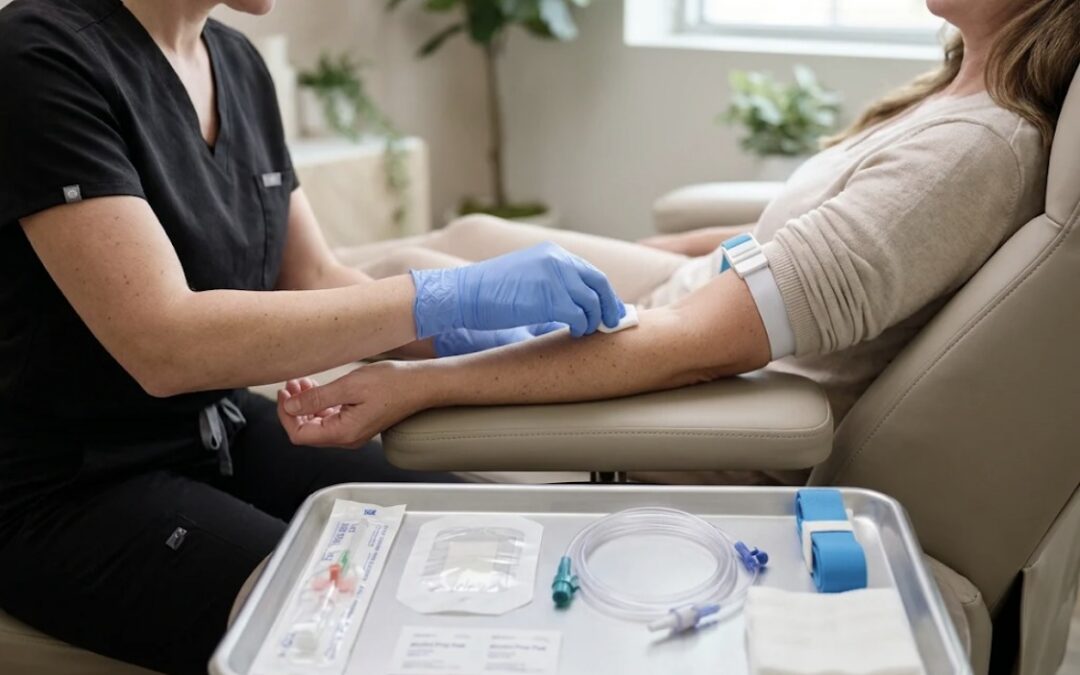
You’ll settle into a private, calm space while we place a small IV, usually in your arm. The infusion starts slowly, and we stay close during the first few minutes, since the Canadian consensus notes reactions are most likely within the first 10 minutes. We check in on how you’re doing at the start, partway through, and at the end.
After the Infusion
Once the drip finishes, we monitor you for a short while before you head out. Most people go straight back to their day. Before you leave, we review your aftercare instructions and confirm your next appointment.
What Affects the Length of Your Iron Infusion
No two plans look exactly alike. A few factors shape your time in the chair and how many visits you’ll need.
- The type of iron. Some IV iron products deliver a large dose in one sitting. We use iron sucrose (Venofer), which is given in smaller doses spread over several visits.
- The dose per session. With iron sucrose, a larger dose means a longer drip. Product information cited in the Canadian consensus lists about 15 minutes for 100 mg and about 2.5 hours for 400 mg.
- Your health history. Past reactions, allergies, kidney health, and current medications all matter.
The table below gives a general picture of how common IV iron options compare. Your provider chooses the product based on your labs and history.
| IV iron type | Typical time per dose | Usual number of visits |
|---|---|---|
| Iron sucrose (Venofer) | About 15 minutes to 2.5 hours, depending on dose | Several |
| Ferric carboxymaltose | About 15 minutes | Usually 2, at least a week apart |
| Ferumoxytol | About 15 to 30 minutes | 1 to 2 |
| Ferric desferrioxamine | About 15 to 30 minutes | Usually 1 |
| Low molecular weight iron dextran | About 1 hour or longer | Usually 1 |
How Many Iron Infusion Sessions Will You Need?
Two things decide this: your total iron shortfall and how much iron you receive at each visit. Because iron sucrose comes in smaller doses, delivering the full amount usually takes several sessions.
At your consultation, we’ll lay out your series, including how many visits we recommend and how far apart they’ll be. A repeat blood test afterward shows whether your iron stores have recovered. If something ongoing, like heavy periods, keeps pulling your iron down, you may need another course later.
When Might You Start to Feel a Difference?
Timing varies by person. Some people notice more energy within a few days. The ASH review describes one patient whose energy improved within 48 hours, but that was a single case, not the norm.
Lab numbers move more gradually. Hemoglobin levels tend to rise over several weeks as your body uses the new iron to build red blood cells. In the ferumoxytol study, researchers measured results with labs drawn within 12 weeks of treatment. That’s why we recheck your labs rather than relying on how you feel alone.
Is an Iron Infusion Safe?
Modern IV iron has a strong safety record. The Canadian consensus estimates serious allergic reactions at fewer than 1 in 200,000 cases, and the ASH review notes that older concerns about IV iron largely trace back to earlier formulations.
As with any medical procedure, some risk remains. Mild, short-lived reactions such as flushing, muscle or joint aches, back discomfort, or chest tightness can happen. They typically settle on their own without treatment, and delayed reactions are very rare.
Before your infusion, let your provider know if you’ve had a reaction to IV iron, have several drug allergies, or take beta blockers or ACE inhibitors. This helps us plan your care safely.
Iron Infusions in Tampa With Diane Genne, APRN, OCN

Choosing who places your IV matters. Diane Genne, a nurse practitioner with more than 25 years of clinical experience, leads your care at Wellness IV Bar. She also holds the OCN credential, which stands for Oncology Certified Nurse. It’s a certification for nurses who specialize in cancer care, where IV therapies and close patient monitoring are part of everyday work.
Diane’s philosophy is simple: no guesswork and no pressure. She reviews your labs, listens to how you’ve been feeling, and builds a plan around what your body actually needs. Our goal is to help you look better, feel better, and age better, and restoring healthy iron levels is often one piece of that bigger picture.
The Bottom Line
So, how long does an iron infusion take? Plan on about 15 to 60 minutes of drip time per dose, plus time for setup and monitoring, across what may be several sessions. Your labs and health history set the exact timeline, which is why every plan here starts with a conversation.
Frequently Asked Questions About Iron Infusions
Why Come to Wellness IV Bar for Iron Infusions?
Diane has over 25 years of experience working with patients needing Iron at Moffitt and Florida Cancer and is familiar with possible side effects during treatments.
How long does an iron infusion take from start to finish?
Drip time often runs 15 to 60 minutes, depending on the product and dose. Allow extra time for check-in, IV placement, and monitoring afterward. We’ll give you a clear estimate at your consultation.
Can I go back to work after an iron infusion?
Most people return to their usual routine the same day. If you feel off after your infusion, tell us before you leave so we can check on you.
How soon will I feel better after an iron infusion?
It varies. Some people notice more energy within a few days, while lab improvements typically take several weeks.
Do I need a blood test before an iron infusion?
Yes. Labs confirm iron deficiency and help us calculate how much iron you need. If you don’t have recent results, we can help you get them.
Why does my iron infusion take more than one visit?
We use iron sucrose (Venofer), which is given in smaller doses per session. We divide your total dose across a short series of visits.
Feel Like Yourself Again
If low iron has been holding you back, a conversation is a good first step. Book your personalized consultation at Wellness IV Bar in Tampa, and Diane will review your labs, answer your questions, and help you decide whether an iron infusion makes sense for you. Text us today at (813) 290-1994.

Diane Genne, APRN, OCN, is a board-certified nurse practitioner, oncology certified nurse, and founder of Wellness IV Bar & Aesthetics in Tampa, Florida. She brings 25 years of infusion experience to her practice, where she provides personalized care in IV therapy, medical weight management, hormone therapy, and aesthetics.